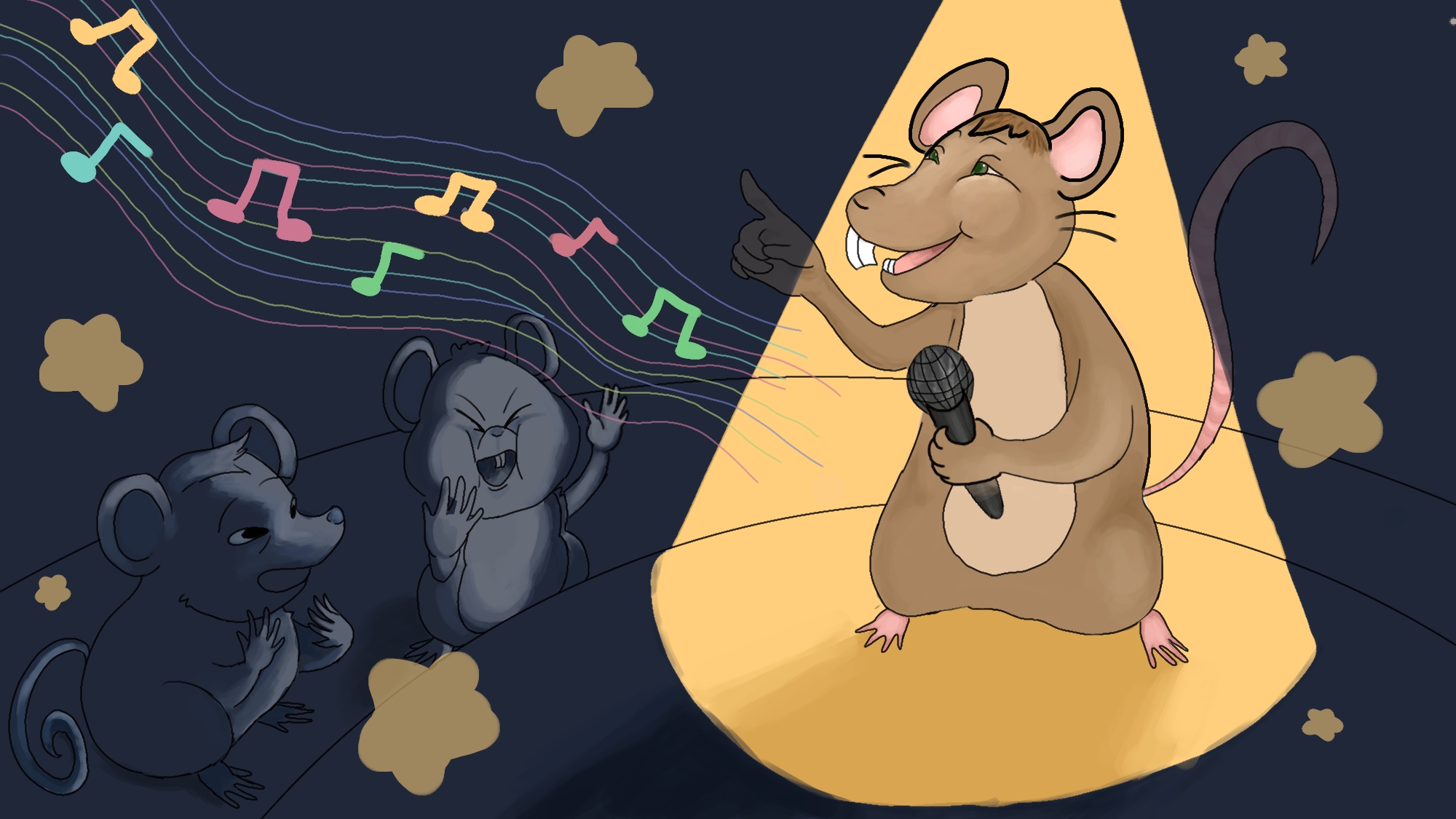
Deep within the tropical forests of Costa Rica, a duet of high-pitched chirps ring out. As if they were mid-conversation, these Alston’s singing mice (Scotinomys teguina) call to one another, putting on a concert for the entire forest to hear.
The vocal virtuosity of these mice could help scientists better understand a common and complicated condition known as autism spectrum disorder (ASD). Deeper insights into ASD could, in turn, open possibilities for behavioral therapies or other treatments.
ASD is an umbrella term that likely covers a wide range of neural disorders. The condition affects millions of people around the globe by altering their brain’s circuitry, influencing how they act, communicate, and understand the world around them. For people with autism, the effects can range from mild to severe, encompassing varying brain functions.
Scientists believe that autism arises from a combination of genetic and environmental factors. As of now, there is no cure, and treatments are sparse. But Alston’s singing mice are soon to be valuable living animal models used by scientists studying autism.
- Animal models can be used for clinical testing of treatments before human trials.
- The “singing” communication between Alston’s singing mice is comparable to typical human conversation.
- Engineered gene deletion (knockouts) in Alston’s singing mice can help researchers study communication deficits related to autism spectrum disorder.
Dr. Joseph Del Rosario, a postdoctoral researcher at the NYU School of Medicine, proposes that the singing mice can give insight into the effects of autism on verbal communication. Unlike most other animals, these mice take turns “talking” back and forth with little to no delay, leading scientists to hypothesize that their communication is comparable to that of humans.
“With autism, one of the core deficits is vocal communication,” Del Rosario explains. He is working to genetically modify some of the mice to serve as a model for autism. Then, he can explore the genetics and behavior involved with rapid communication, and how vocal communication and response times are impaired by ASD.
Researchers have identified many genes that, when modified, might play a role in the development of autism. These genes have functions ranging from brain communication and development (SHANK3), to memory and learning (FMR1), to cell growth (TSC2).
To produce suitable mouse models for studying genes contributing to autism, Del Rosario needs to decide which genes to focus on. To make the selection, he says he will look for “high-risk autism genes found in humans that are also present in different animal models.” Then, using a gene-editing technique called CRISPR-Cas9, he will “knock out,” or permanently disable those genes, creating what are known as knockout mice. This research approach is widely used to identify which functions go missing after genes are inactivated or removed.
However, using knockout mice to decode communication in autism isn’t straightforward. Del Rosario acknowledges that animal behavior will never perfectly mirror human behavior. For example, scientists studying anxiety have observed marble-burying behavior in stressed-out lab mice. “If you put marbles in a cage, mice bury marbles because they’re stressed,” he says. “That doesn’t really translate well to human behavior.”
Instead, scientists aim to find an animal model to reflect the right behavior. That’s why Del Rosario is so interested in using Alston’s singing mice—one of the only animals known to communicate in rapid back-and-forth messaging—to identify genes that might contribute to the changes in vocal communication seen in autism.
Ultimately, these animal models allow scientists to identify target genes for treating autism and then to study the effects of such treatments, to prevent the need for testing in humans.
“Animal research would always have a place to really investigate [new medications] before you test these treatments in humans,” says Del Rosario. “I would hate to have a potential treatment [for] humans, test it, and find that it’s really detrimental to [human] health.”
The usefulness of these animals for research cannot be understated. As more and more models are developed to study the many and highly variable symptoms of autism, the duet of singing mice could soon be joined by an ensemble of animals—a chorale of hope for the future of autism research.
Sources
Del Rosario, Joseph. (2025, July 8 and July 19). Interviews conducted by Elijah Yu.
Dietz, P.M., et al. (2020). National and state estimates of adults with autism spectrum disorder. J Autism Dev Disord, 50:4258–4266. https://doi.org/10.1007/s10803-020-04494-4
Kazdoba, T. M., et al. (2016). Translational mouse models of autism: advancing toward pharmacological therapeutics. Curr Top Behav Neurosci: Transl Neuropsychopharmacol, 28:1–52. https://doi.org/10.1007/7854_2015_5003
Long Lab, NYU School of Medicine. (n.d.). Research interests. https://longlab.med.nyu.edu/research/#mouse-vocalization
National Library of Medicine (n.d.). Genes. Medlineplus.gov. https://medlineplus.gov/genetics/gene/
Servick, Kelly. (2019, February 28). This singing mouse’s brain could reveal keys to snappy conversation. Science. https://www.science.org/content/article/singing-mouse-s-brain-could-reveal-keys-snappy-conversation
Editorial Team
- Chief Editors: Chloe Eng, Aanya Bulusu
- Associate Editor: Eric Yang
- Team Editor: Ananya Datta
- Graphic Designer: Oriana Reilly
- Social Media Coordinators: Abigail Marquez, Andy Alvarado
- Web Manager: Ananya Datta
Mentor
Alisa Machalek spent her career as a science communicator at the National Institutes of Health. Her main focus was to make biomedical research understandable and interesting to the public. To do so, she created communications products including news and feature articles, print and online magazines, videos, social media, multimedia, posters, and games. Her favorite project was an exhibit of stunning microscopy images displayed in the art gallery of a major airport. Alisa earned B.S. and M.S. degrees in biochemistry, conducted research in 10 different laboratories, then graduated from the science writing program at the University of California, Santa Cruz.
Content Expert
Joseph Del Rosario, PhD, is a postdoctoral associate in the Long Lab at the New York University School of Medicine. He develops and uses animal models of autism to decipher the underlying neural circuitry involved with autism behavior.