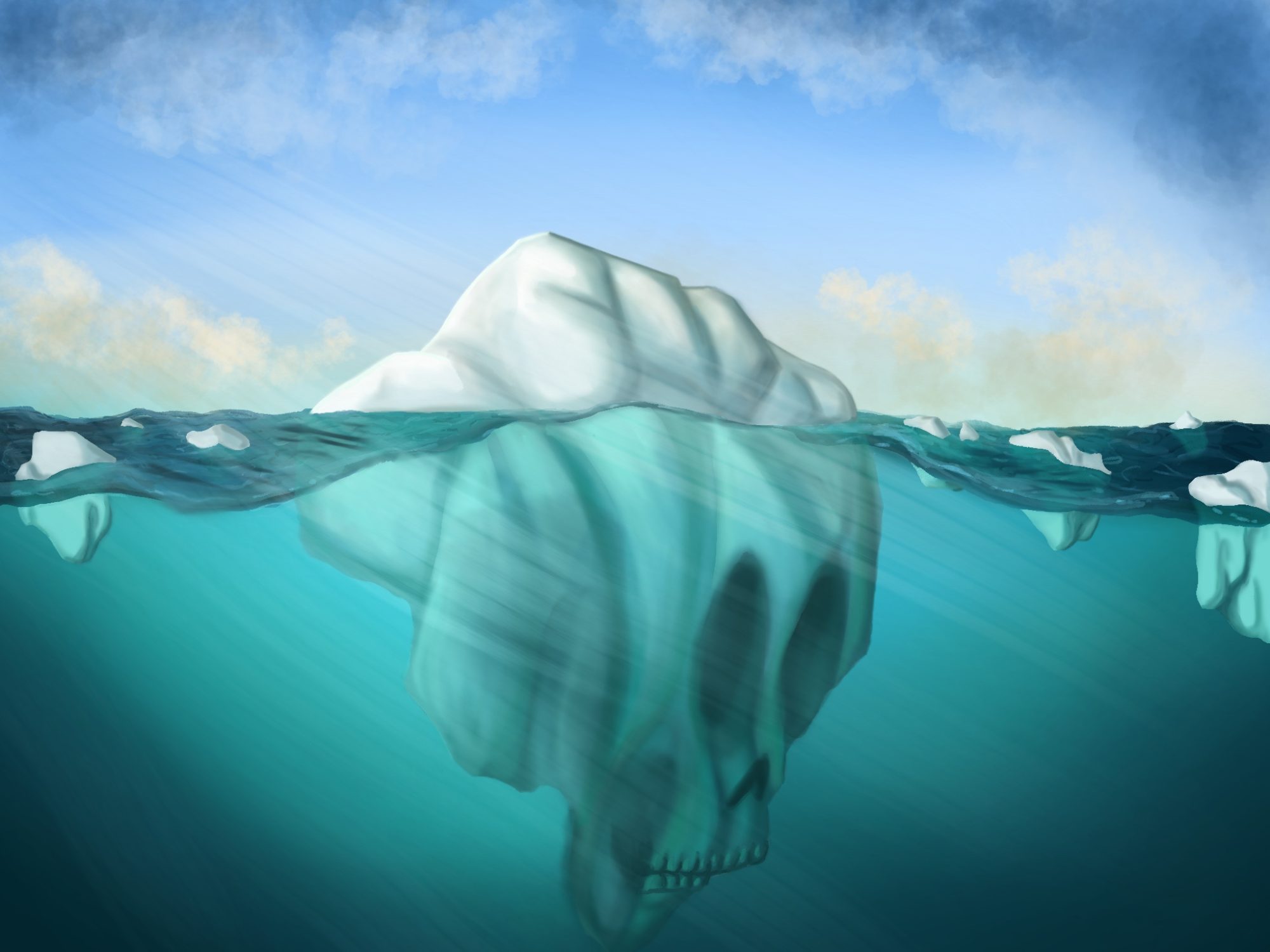

The icy snow of the Siberian Arctic seems paused in time. The frozen ground is hard as stone, covered in a pale layer of frost that stretches out in every direction. As you dig through the thick ice, each meter exposes a world that hasn’t seen daylight in thousands of years. You may expect to discover a fossil or mammoth tusk, but instead, you come across something much smaller and far more unexpected. Buried in the soil, preserved for nearly 50,000 years by the cold, is an ancient virus. It might sound harmless, but it could introduce infections the world has long forgotten or never faced. If viruses were to re-enter the environment, the human race could face a public health crisis unlike any in history.
Today, the Arctic is heating up nearly four times faster than the rest of the planet. Permafrost—frozen soil, rock, and organic matter that is frozen for at least two years— covers about a quarter of the land in the Northern Hemisphere. It is currently softening into slush and mud as a result of global warming. Unfortunately, in addition to storing animal carcasses and plants, permafrost also stores microbes, some of which have not been thawed in thousands of years. Many microbes can survive through permafrost because the extreme cold preserves their structures and genetic material. Some of these are likely to be pathogenic or disease-causing, and present-day humans have no experience with or resistance to them. In particular, viruses are a concern because they can remain infectious even after thousands of years in ice, and once the permafrost thaws, these viruses can regain activity.
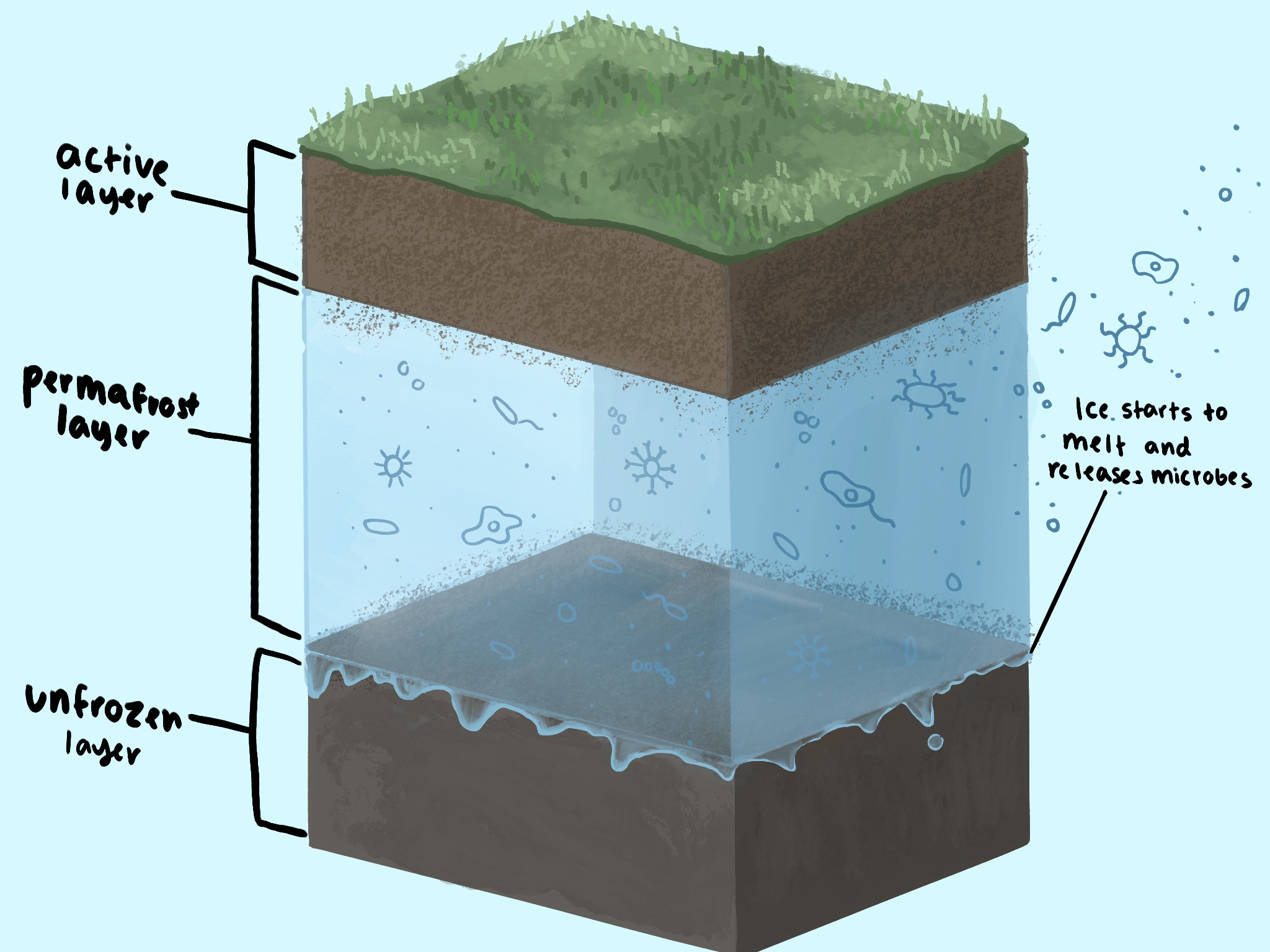
- The Arctic is warming nearly four times faster than the rest of the planet, causing permafrost to thaw at an unprecedented rate.
- Scientists have successfully revived “zombie viruses” up to 48,500 years old, proving that ancient pathogens can re-emerge.
- Climate change is a growing global health threat as well as an environmental crisis.
In 2016, northern Siberia experienced weeks of record-breaking heat. The frozen ground began to thaw in places it had not in decades. Beneath the permafrost lay a reindeer carcass that had died from anthrax. Once the soil softened, Bacillus anthracis, or anthrax spores, were released. It was not long after that the disease took the town by storm. Over 2,000 reindeer died, 90 locals were hospitalized, and one 12-year-old boy lost his life.
For scientists, this outbreak was a wake-up call. Anthrax had been absent in the region for over 70 years, but one thawed animal was enough to bring it back. If a single bacterium could survive for decades and return suddenly, what about other viruses that have been frozen even longer?
Jean-Michel Claverie, an emeritus professor at the School of Medicine of Aix-Marseille University in France, has been studying these “zombie viruses” for years. His lab has revived giant viruses—large strains that can be seen under standard light microscopes—up to 48,500 years old from permafrost samples, proving that ancient pathogens can remain infectious long after their hosts have passed away. Claverie is especially worried about what could happen as industrial activity expands in the Arctic, as “mining in permafrost-covered regions first consists in removing up to one kilometer of frozen permafrost layers to reach valuable minerals,” he says. “Doing this may release zillions of bacteria and unknown viruses in the air, for miners to inhale, touch, and eventually get sick from.”
Audrée Lemieux offers a different perspective through her recent study of viral spillover risks, which is the potential for pathogens to move from one animal to another when a virus jumps from species to species. Lemieux is a research coordinator at the Institut du Savoir Montfort in Ottawa, Canada, but when she was an undergraduate at the University of Ottawa (2018-2021), she and colleagues studied how increasing glacier runoff fragmented the environment in the Canadian High Arctic. More runoff from when permafrost or glaciers melt was linked to a higher risk of viral spillover. “Fragmented habitats can isolate populations of viruses and hosts, which speeds up their co-evolution and increases the diversity of viruses,” Lemieux explains.
This greater diversity could mean more opportunities for viruses to spill over, especially if bridge vectors—animals that transmit pathogens between different species, like mosquitoes—were present. Lemieux stressed that her team’s findings do not prove a spillover will surely happen, but that the risk increases considerably with climate change.
The revival of anthrax in 2016 and the warnings from Claverie and Lemieux spotlight one truth: Climate change is not only an environmental issue, it is a health issue. Melting permafrost is like opening a time capsule filled with ancient viruses that can catch humankind completely off guard. Scientists are increasingly concerned about the possibility of older, stranger viruses emerging, against which we have no immunity, vaccines, or treatments. Lemieux notes that climate change could fragment habitats and increase the diversity of viruses, while Claverie warns that “zillions” of ancient microbes could be released by human activities. The evidence is clear—but can we respond in pace with the thaw?
Sources
Alempic, J.-M., et al., including Claverie, J.-M. (2023). An update on eukaryotic viruses revived from ancient Siberian permafrost. Viruses 15(2): DOI:10.3390/v15020564. https://pubmed.ncbi.nlm.nih.gov/36851778/
Bamber, J. (2022, August 15). The Arctic is warming nearly four times faster than the rest of the world. PBS NewsHour. https://www.pbs.org/newshour/politics/the-arctic-is-warming-nearly-four-times-faster-than-the-rest-of-the-world
Browne, G. (2022, October 27). Thawing permafrost exposes old pathogens—and new hosts. WIRED. https://www.wired.com/story/arctic-spillover-risk/
Claverie, Jean-Michel. (2025, August 27). Interview conducted by Sara Wang.
Emerson, J. B. et al. (2018). Host-linked soil viral ecology along a permafrost thaw gradient. Nat Microbiol 3:870–880. https://www.nature.com/articles/s41564-018-0190-y
Güell, O. (2024, April 29). Researcher Jean-Michel Claverie: “The next pandemic may come from a virus that emerged from permafrost.” El Pais. https://english.elpais.com/science-tech/2024-04-29/researcher-jean-michel-claverie-the-next-pandemic-may-come-from-a-virus-that-emerged-from-permafrost.html
Hunt, K. (2023, March 8). Scientists have revived a “zombie” virus that spent 48,500 years frozen in permafrost. CNN. https://www.cnn.com/2023/03/08/world/permafrost-virus-risk-climate-scn
Lemieux, Audrée. (2025, August 25). Interview conducted by Sara Wang.
Lemieux, A., et al. (2022). Viral spillover risk increases with climate change in High Arctic lake sediments. Proc Biol Sci 289 (1985): 20221073. https://pubmed.ncbi.nlm.nih.gov/36259208/
McKie, R. (2024, January 21). Arctic zombie viruses in Siberia could spark terrifying new pandemic, scientists warn. The Guardian. https://www.theguardian.com/society/2024/jan/21/arctic-zombie-viruses-in-siberia-could-spark-terrifying-new-pandemic-scientists-warn
Editorial Team
- Chief Editor: Chloe Eng
- Associate Editor: Eric Yang
- Team Editor: Ananya Datta
- Graphic Designer: Audrey Hosmer
- Social Media Coordinators: Abigail Marquez, Andy Alvarado
- Web Manager: Ananya Datta
Mentor
- Jonathan Heiman is a physician whose career has spanned inpatient and outpatient care, along with roles in administration and teaching. Trained in both internal medicine and pediatrics, his passion has always been most apparent when working with younger patients. A lifelong learner, he believes curiosity is the foundation of thoughtful problem-solving and meaningful connection. His interest in science communication grew naturally from his work with patients and families, where clear explanations often made all the difference. In recent years, his fascination with epidemiology, public health, cognitive theory, and climate science has inspired him to reach a broader audience. Watching young scientists discover what excites them continues to motivate him to mentor the next generation of science communicators.
Content Expert
Jean-Michel Claverie, PhD, is an emeritus professor at the School of Medicine of Aix-Marseille University in southern France and a leading authority on ancient and emerging viruses. After earning his doctorate at the University of Paris, he held research positions at major institutions including the French National Centre for Scientific Research, the Salk Institute, the Pasteur Institute, and the National Institutes of Health. He is a pioneer in the field of paleovirology and discovered the first infectious viruses preserved in Siberian permafrost.
Audrée Lemieux, MS, is a research coordinator at the Institut du Savoir Montfort in Ottawa, Canada. She earned her bachelor’s degree in biology at the University of Ottawa, and studied HIV at the Université de Montréal to obtain her master’s degree in microbiology and immunology. Her work includes studies of viral spillover risk in High Arctic environments that examine how melting glaciers and permafrost influence the potential for viruses to jump between species.